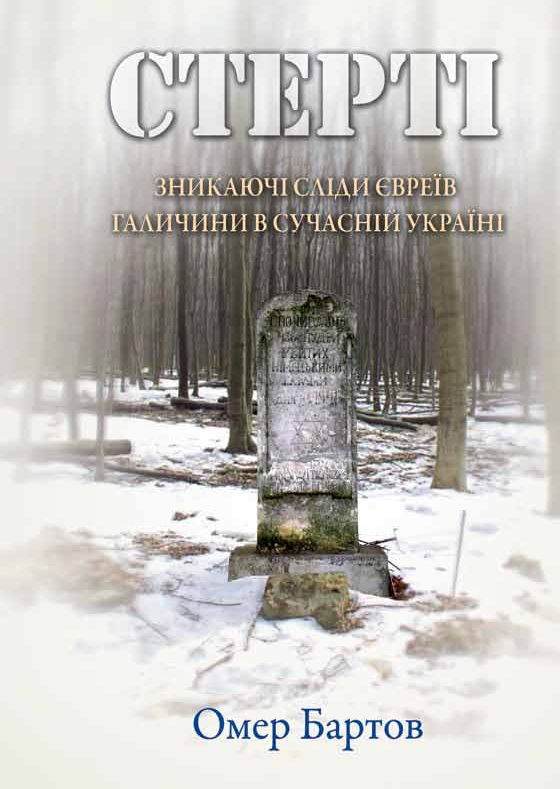
The book "Erased" by famous American historian Omer Bartov
The book "Erased" by famous American historian Omer Bartov is devoted to certain aspects of historical memory about the Holocaust and its formation in modern Ukraine. The main focus of the book is erasing of the materials heritage and memory of Jewish life in western Ukraine (eastern Galicia). To emphasize the significance of such erasure and show some reasons for this process, the author begins with a short history of Jewish communities in many cities and villages in Galicia before WWII and then tells how they were killed during the German occupation of the region. During his trip in eastern Galicia the author lived a personal shock: he was amazed at almost total absence of memory about the killings of Galician Jews. The work by O.Bartov has a turning point around readiness or unreadiness of the modern Ukrainian state and society to see the history of the Holocaust, generally the history and culture of Ukrainian Jews, as a part of own national history and national heritage with its all positive and negative events in the history of Ukrainian-Jewish relations. We hope that the Ukrainian translation of the book "Erased" will serve the historians dealing with the Jewish studies, the Holocaust, WWII and that it will foster open discussion on forming the complex and true memory about the past and responsibility for this memory in Ukrainian society today. The book was printed by "Zovnishtorgvydav Ukrainy" and Ukrainian Center for Holocaust Studies under the support of Matra Programme of the Ministry for Foreign Affairs of the Netherlands, Anne Frank House, and Central and East European Book Publishing Projects Fund (Amsterdam).
Announcements
MoreLatest News
-
International Scientific-Practical Conference “Unity in Diversity: The Historical, Socio-Cultural and Geopolitical Dimension of the EU’s Core Idea for Ukraine”
On May 14-15, 2026, Oles Honchar Dnipro National University hosted the International Scientific-Practical Conference Unity in Diversity: The Historical, Socio-Cultural and Geopolitical Dimension of the EU’s Core Idea for Ukraine. The event was held within the Erasmus+ Jean Monnet Module project European Multiculturalism as an Experience and a Path for Ukraine’s European Integration with financial support from the European Union.
[More] -
The XXVI I.B. Medvynsky All Ukrainian Competition of Student Research and Art Works “History and Lessons of the Holocaust”
On May 16-17, 2026, Kyiv hosted the XXVI I.B. Medvynsky All‑Ukrainian Competition of Student Research and Art Works History and Lessons of the Holocaust. This year, 106 entries were submitted from across Ukraine, with 52 reaching the final stage. Nearly 100 participants from 14 regions took part.
[More] -
Day of Remembrance for Ukrainians Who Rescued Jews During World War II
On the Day of Remembrance for Ukrainians who rescued Jews during World War II, Anatolii Podolskyi, Director of the Ukrainian Center for Holocaust Studies, took part in a conversation on Radio Kultura.
[More] -
Unveiling of the Stumbling Stone in honour of Isaak Libovych
On May 6, Kyiv unveiled its 15th Stumbling Stone in honour of Isaak Libovych. The ceremony, held on the Day of Remembrance and Victory over Nazism, was part of the international project One Stone - One Life. 80 Stumbling Stones for Kyiv.
[More] -
Exhibition “(No) Children’s Stories” in Kovel
After its run in Kyiv in April, the exhibition (No) Children’s Stories will be hosted in Kovel from May 5 to 22, 2026. Created by the Ukrainian Center for Holocaust Studies with support from the international project Paths of Memory III.
[More]