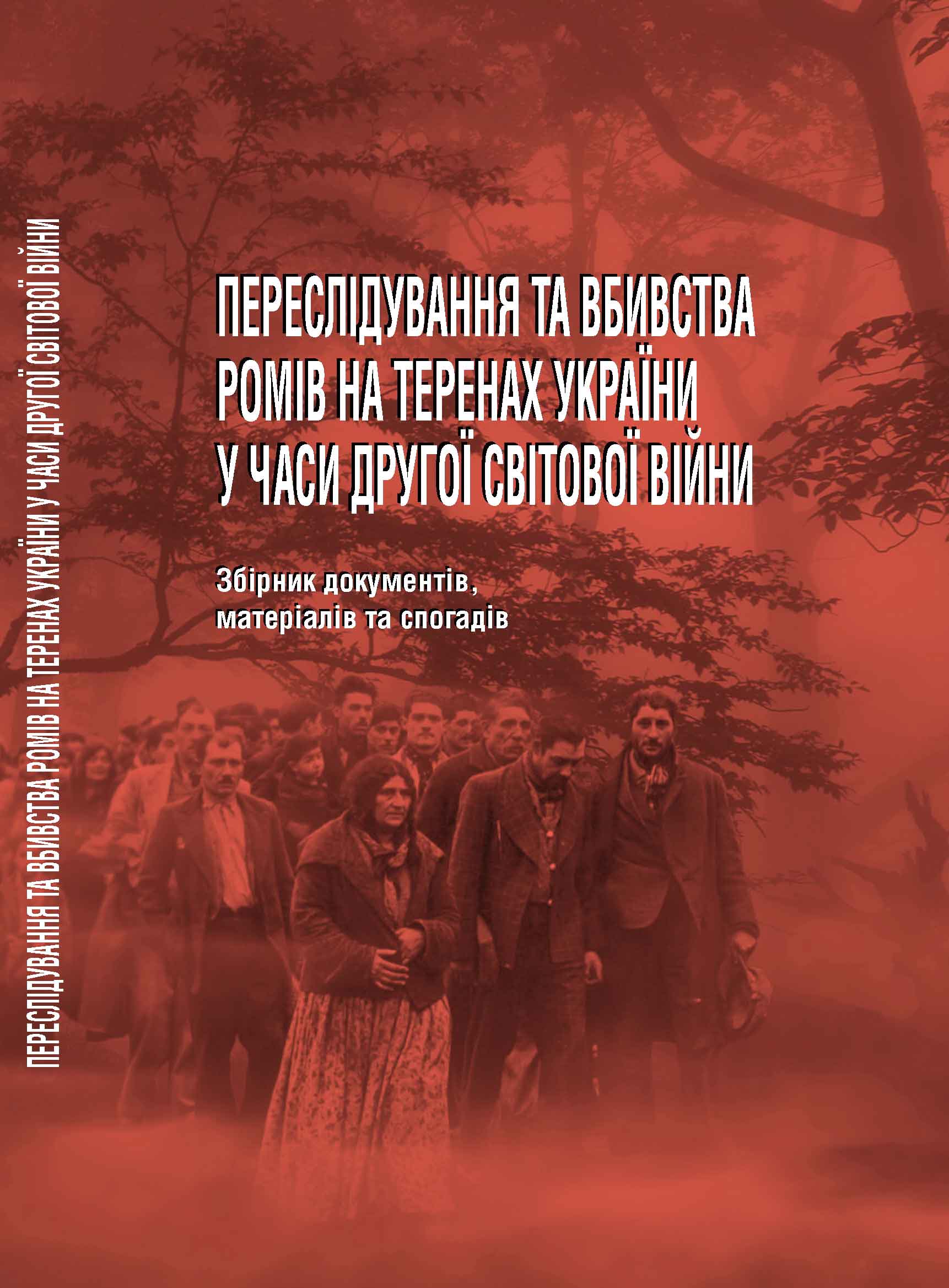
Persecution and mass murder of the Roma in Ukraine during the World War II: Collection of documents, testimonies and related materials (Ed. by Mikhail Tyaglyy). Kyiv: Ukrainian Center for Holocaust Studies, 2013, 208 p. [in Ukrainian]. ISBN 978-966-2214-31-4
The aim of the collection is to attract attention of the historians, educators and wider audience to the problematic of the persecution and extermination of the Roma in Ukraine occupied by the Nazis in 1941-44. The book presents the issues understudied, the patterns of the historical sources which are still unexplored by the scholars, and the original testimonies recorded from the Roma survivors and those non-Roma eyewitnesses of the persecution.
The book consists of three chapters.
- Chapter 1. Records of the governmental bodies, occupation administrative authorities and security apparatus, local administrations and auxiliary structures, postwar investigating agencies and justice agencies;
- Chapter 2. Oral history testimonies recorded from the Roma survivors and non-Roma witnesses of the Roma genocide in Ukraine occupied, 1941-44;
- Chapter 3. Papers by the winners of the “Forced labor, persecution and massacres of the Roma in the Ukraine occupied, 1941-44” section at the XIII Annual competition of the pupil’s papers “History and lessons of the Holocaust” (Kyiv, May 2013).
Three appendixes contain:
(1) Statistical diagrams showing the cases of the mass murder of the Roma in the German-occupied Ukraine, both in the areas under military control and civil administration;
(2) Map of the Ukrainian locations where the Roma were murdered (as known from the sources explored up to present);
(3) Bibliography of the recent items of the Roma genocide in the Ukraine occupied in 1941-44.
The book is result of the research and educational project run in 2012-13 by the Ukrainian Center for Holocaust Studies and supported by the International Foundation “Mutual Understanding and Tolerance”.
The electronic version of the book can be downloaded for free from the UCHS’ website at: roma_book.pdf
To obtain a hardcopy, please contact Mikhail Tyaglyy at mikhail.tyaglyy@gmail.com
Announcements
MoreLatest News
-
Research Team Meeting for the Project “One Stone - One Life: 80 Stumbling Stones for Kyiv”
On 13 December 2025, the first in‑person meeting of school research teams took place in Kyiv. These teams are currently studying the biographies for new Stumbling Stones. Five teams from Kyiv and one from Odesa - history teachers working together with their students - are each conducting their own research.
[More] -
Mnemonika NGO Held a Workshop on Holocaust Remembrance and Related Educational Practices
On 5-6 December 2025, Mnemonika NGO held a workshop in Rivne that brought together educators from across Ukraine to explore Holocaust remembrance, the local history of Sosonky, and contemporary approaches to teaching sensitive topics.
[More] -
Educational and Methodological Seminar for Ukrainian Educators at Yad Vashem (Jerusalem)
On 23–29 November 2025, a seminar for Ukrainian history teachers was held at the Yad Vashem Memorial. After a six‑year break, the Ukrainian Centre for Holocaust Studies resumed its annual teacher‑training programme in Jerusalem, one of its longest‑running educational initiatives, launched in 2006.
[More] -
The “Remembrance in Dialogue” Educational Project for Ukrainian Teachers
On 19 November 2025, within the framework of the Remembrance in Dialogue project organized by Insha Osvita and Austausch, a workshop was held for school history teachers dedicated to researching and teaching local Holocaust histories. The project focuses on preserving the memory of the Holocaust during Russia’s war against Ukraine.
[More] -
Blasphemy, Indifference, and Russian Propaganda: The Story of the Failed Creation of the Babyn Yar Museum
The Museum of the History of Kyiv has published a study by well-known Ukrainian historian Vitalii Nakhamanovych on the history of attempts to create a museum in Babyn Yar, the struggle for historical memory of this crime and tragedy in the history of Ukraine during World War II, a struggle that continues to this day.
[More]