The Roma Holocaust Memorial Day
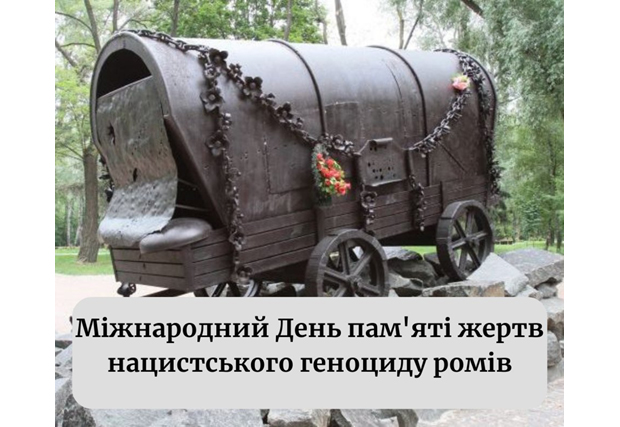 On August 2, the memory of the victims of the Nazi genocide of the Roma is commemorated at the international level. This date is a tribute to those who died as a result of genocide during the Second World War. On the night of August 2-3, 1944, about three thousand Roma, including children and the elderly, were burned alive in the gas chambers of the Auschwitz-Birkenau death camp. Probably between 300,000 and 500,000 Roma died during National Socialism. In total, more than 20 thousand Ukrainian Roma died on the territory of Ukraine. This genocide left a deep scar on the souls of hundreds of thousands of people, and its traces continues to be felt today.
For many years, the UCHS has been paying attention to the study of the history of the genocide of the Roma people. Various scientific and pedagogical publications have been published, which can be found on our official website:
- Persecution and mass murder of the Roma in Ukraine during the World War II: Collection of documents, testimonies and related materials (Ed. by Mikhail Tyaglyy). Kyiv: Ukrainian Center for Holocaust Studies, 2013, 208 p.
[in Ukrainian] https://www.holocaust.kiev.ua/other/details/presl_ta_vbiv?objId=2021
- Genocide of the Roma of Ukraine during the Second World War: study, teaching, commemoration. Materials of the scholar and practical conference, Kyiv, October 4, 2016. Kyiv: Ukrainian Center for Holocaust Studies, 2016, 230 p. [in Ukrainian] https://www.holocaust.kiev.ua/other/details/gen_rom_2016?objId=2021
- Roma: Myths and Facts. A Teacher’s Guide on Countering Antigypsyism. с. [in Ukrainian] https://www.holocaust.kiev.ua/other/details/prot_rom2018?objId=2022
- Holocaust and modernity Scholarly Journal. ISSUE № 2 (6) (2009) [in Ukrainian] https://www.holocaust.kiev.ua/other/details/nauk_chasopis2_2009_en?objId=2019
- The Center has created a separate website on the history of the genocide of the Roma in Ukraine as part of the project " Despised Genocide". The fate of Roma in the zone of German occupation of Ukraine during the Second World War". [in Ukrainian] http://romagenocide.com.ua/
- EXHIBITION ABOUT THE GENOCIDE OF THE ROMA IN TRANSDNISTRIA [in Ukrainian] http://romagenocide.com.ua/vystavka-pamyatai-aby-protystoyaty/
- EXHIBITION "DESPISED GENOCIDE". THE FATE OF THE ROMA IN THE ZONE OF GERMAN OCCUPATION OF UKRAINE [in Ukrainian] http://romagenocide.com.ua/vystavka-znevazhenyi-henotsyd/
We remember!
#RomaHolocaustMemorialDay#Tolerance #Respect #Unity


